
Location and geography
Located at the crossroads of Eastern Europe and Central Asia, Azerbaijan occupies the western shore of the Caspian Sea, bordered to the north by Russia (Dagestan), to the northwest by Georgia, to the west by Armenia and to the south by Iran. The country covers approximately 86,600 km² with a population of nearly ten million, half of whom live in the capital Baku. To the west, the Greater Caucasus peaks rise above 4,000 metres, while the Kura-Araks lowland stretches through the centre and southeast towards the Caspian shore — the world’s largest inland body of water.
This contrasting relief produces an exceptional diversity of landscapes: beech and oak forests in the Caucasus highlands, arid steppes near the Caspian, the world’s most significant mud volcanoes on the Gobustan plateau, and the semi-deserts of Nakhchivan. The climate ranges from subalpine at altitude to humid subtropical along the coast.
History
Azerbaijan is one of the cradles of Caucasian civilisation. From the first millennium BC, the Medes and then the Achaemenids ruled these lands. The country subsequently experienced the conquests of Alexander the Great, Parthian and Sassanid influence, and the spread of Islam in the 7th century, which has lastingly shaped Azerbaijani cultural identity.
In the Middle Ages, Baku and Shamakhi became prosperous trading centres on the Silk Road, attracting merchants, craftsmen and scholars from across the Orient. Safavid rule (16th–18th centuries), followed by Russian dominance from 1806, introduced new influences while preserving local culture. The first democratic republic in the Muslim world was proclaimed in 1918 in Baku, before Soviet absorption in 1920. Independence regained in 1991 opened a new era marked by the oil boom and spectacular modernisation.
Baku, the “Paris of the Caspian”
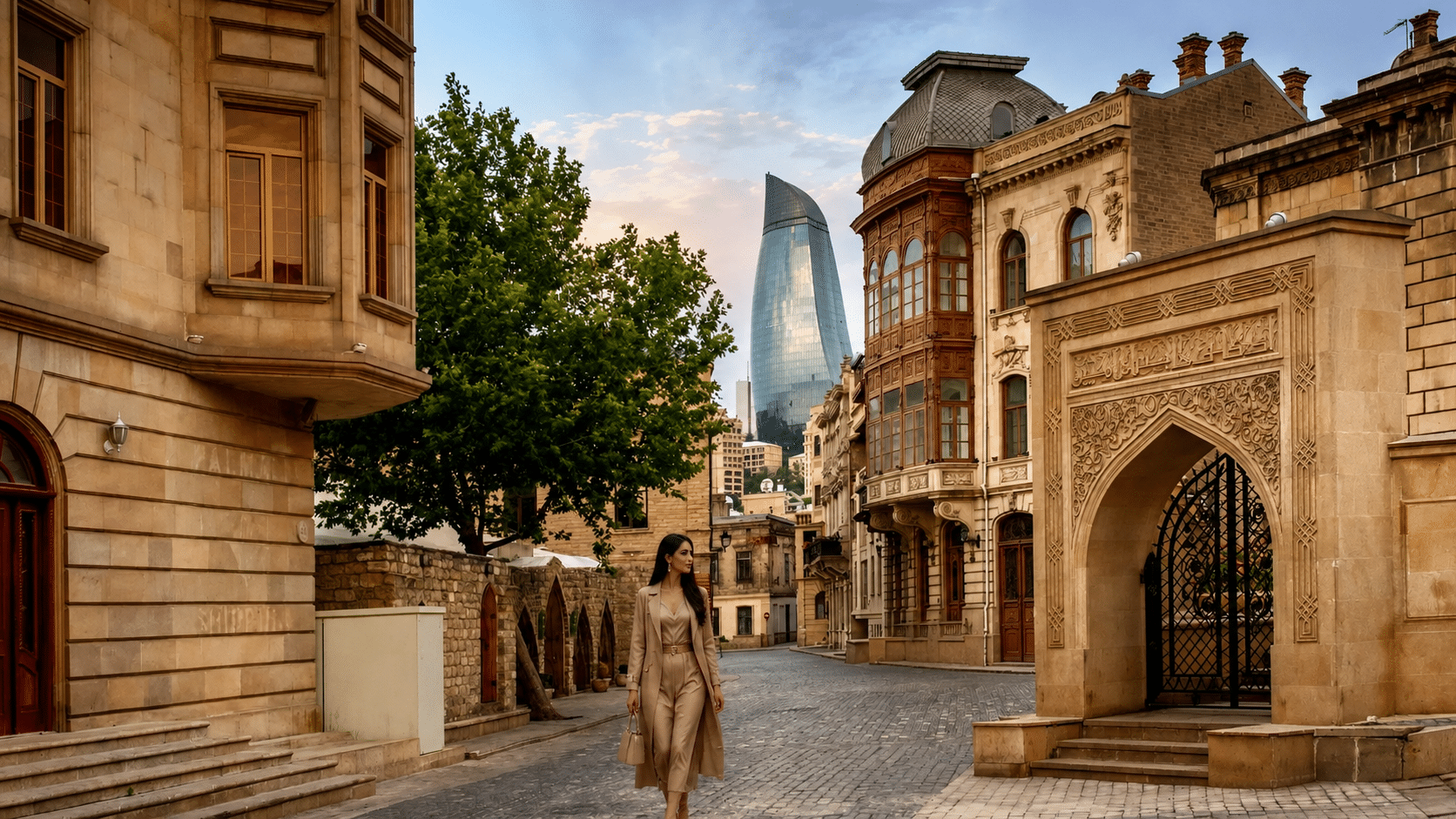
Baku captivates with its striking contrasts: the medieval walled city (Icherisheher), a UNESCO World Heritage Site, stands beside the Flame Towers whose illuminated curves light up the capital’s night sky. The Palace of the Shirvanshahs (15th century) and the Maiden Tower, the city’s millennial emblem, bear witness to a history layered between East and West.
The Caspian seafront boulevard (Bulvar), redesigned over 25 kilometres along the shore, showcases bold modernist architecture by international studios: the Heydar Aliyev Centre (Zaha Hadid), the Boulvar Park, and the Formula 1 Grand Prix circuit that runs annually through the city streets. The Carpet Museum and the Museum of Azerbaijani Arts convey the richness of the country’s craft traditions.
Must-see sites
Gobustan — 65 km south of Baku, the national park contains over 6,000 petroglyphs dating from 5,000 to 40,000 years ago, listed by UNESCO. The nearby mud volcanoes, a remarkably rare geological phenomenon, lend a surreal character to the landscape.
Sheki — A jewel of the western Caucasus, this mountain town is famous for its 18th-century Khan’s Palace, adorned with extraordinarily delicate coloured glass mosaics (shebeke), and its medieval caravanserais. Listed by UNESCO in 2019, Sheki is the undisputed capital of Azerbaijani cultural tourism.
Lahij — A craftsmen’s village perched in Caucasus gorges, renowned for its coppersmiths who have perpetuated a UNESCO-recognised metal-working tradition for centuries.
Gabala and the Karabakh region — Gabala offers lush mountain landscapes and highland lakes, while Shusha, a historic fortress city in Karabakh, is currently being restored.
Ateshgah Fire Temple — On the Absheron Peninsula, this 17th-century Zoroastrian temple, a pilgrimage site for fire worshippers from India and Persia, bears witness to millennia of natural gas seepage that fed its sacred flames.
Yanar Dag (Burning Mountain) — A few kilometres from Baku, a hillside has burned continuously for centuries, a spectacular manifestation of the natural gases escaping from Azerbaijani soil.
Culture and traditions
Azerbaijan is a Turkic-Iranian nation with a Shia Muslim majority, marked by a moderate Islam and a culture of tolerance. Mugham music, a lyrical improvisation recognised by UNESCO as a masterpiece of the oral heritage of humanity, forms the heart of Azerbaijani musical identity. Traditional instruments — tar, kamancha, balaban — accompany the tales of ashughs, itinerant poet-singers.
Carpet weaving, an ancestral art passed from generation to generation, is also inscribed on the UNESCO list. Each region has its distinctive patterns, and carpets from Baku, Quba, Sheki or Karabakh are works of art in their own right, prized by collectors worldwide.
Novruz, the Persian New Year celebrated at the spring equinox, is the most important national holiday, blending ancestral rituals, bonfires, dances and family feasts.
Gastronomy
Azerbaijani cuisine, generous and fragrant, blends Persian, Turkish and Caucasian influences. Plov (saffron pilaf) is the quintessential festive dish, available in dozens of regional variations. Dolmas (vine leaves or vegetables stuffed with meat and herbs), marinated meat kebabs grilled over charcoal, and hearty soups such as piti (lamb and chickpea stew cooked in a clay pot) are among the unmissable dishes.
Tea culture is omnipresent: served piping hot in pear-shaped glasses (armudu), accompanied by cherry or walnut jam and Sheki nougat, tea punctuates all social interactions. Baku also boasts a remarkable contemporary dining scene, blending revisited Azerbaijani cuisine with international influences.
Practical information
Visa — French, Belgian and Swiss nationals can obtain an e-visa (ASAN Visa) online within a few hours from the official Azerbaijani government website, for a tourist stay of up to 30 days.
Currency — The Azerbaijani manat (AZN). International credit cards are widely accepted in Baku; less so outside the capital.
Language — Azerbaijani (Turkic) is the official language. Russian is still understood by older generations; English is increasingly spoken in Baku’s tourism sector.
Time zone — UTC+4 (2 hours ahead of France in winter, 1 hour in summer).
Best time to visit — Spring (April–June) and autumn (September–October) offer the most pleasant temperatures. Summer in Baku can be sweltering (35–40°C); the mountain regions remain cool year-round.
Health and safety — Azerbaijan is a safe country for travellers. No compulsory vaccinations; consult your doctor for standard recommendations.